

Dispersionsfarbe: Die universelle Wandfarbe
Dispersionsfarbe ist eine synonyme Begrifflichkeit für Wandfarbe oder Deckenfarbe. Doch alle meinen letztlich dasselbe. Möchtest Du Deinen Räumlichkeiten im Innenbereich einen neuen Anstrich verpassen, dann greife auf die weißen oder mit Pigmenten versetzten Dispersionsfarben zurück. Sie bestehen aus Bindemitteln, Wasser sowie Füll- und Zusatzstoffen. Die Vorteile der Wandfarben für die Renovierung Deiner Wohnräume liegen in der hohen Deckkraft, der guten Haftbarkeit, der Wischfestigkeit, der schnellen Trocknung und der einfachen Verarbeitung. Umweltfreundliche Varianten der Dispersionsfarbe sind ohne Lösungsmittel und Weichmacher, erkennbar an der Geruchsneutralität. Als Bindemittel kommen Natur- oder Kunstharze zum Einsatz. Damit Du für Dein nächstes Projekt bestens informiert bist, verraten wir Dir nachfolgend alles, was Du über Dispersionsfarbe wissen musst.
Dispersionsfarbe, Latexfarbe, Mineralfarbe: Was sind die Unterschiede?
Für unterschiedliche Untergründe eignen sich verschiedene Dispersionsfarben. Das liegt vor allem daran, weil Flächen in Räumen immer anderen Belastungen standhalten müssen. Ein Untergrund im Treppenhaus oder Flur wird stärker beansprucht als andere Räumlichkeiten, während im Bad eine hohe Luftfeuchtigkeit besteht. Hier besteht die Gefahr von Schimmel. Die Wände im Wohnzimmer oder Schlafzimmer sind hingegen, was den Anstrich betrifft, unkompliziert.
Eigenschaften Dispersionsfarbe
Unter Dispersionsfarbe fallen unter anderem Wandfarben, Abtönfarben und Silikatfarben. Meist sind die Anstriche dickflüssig, lassen sich aber gut mit Wasser verdünnen. Dispersionsfarbe ist besonders vielseitig und bietet als Anstrich einen großen, gestalterischen Spielraum.
Die Farbe besteht aus Kunstharz als Bindemittel, Wasser als Lösungsmittel, Farbpigmenten für die Farbe, Füllstoffen zur Verbesserung der Deckkraft und Konsistenz, sowie verschiedenen Zusatzstoffen wie Konservierungsmitteln und Verdickungsmitteln, die die Haltbarkeit und Verarbeitbarkeit der Farbe verbessern.
Kunstharzdispersionsfarbe überzeugt mit einer hohen Deckkraft, der guten Haftung an Wänden, der Nassabriebfestigkeit, der Atmungsaktivität und der Vielzahl an Farbmöglichkeiten. Unser BAUFIX Maler-Raumweiß zeigt sich zum Beispiel in einem seidenmatten Schimmer und ist als lösemittelfreie Variante erhältlich, die frei von Konservierungsmitteln ist.
Haltbarkeit von Dispersionsfarben
Geschlossene Farben sollten maximal 5 Jahre aufbewahrt werden. Geöffnet ist ein zügiger Verbrauch innerhalb von 12 Monaten zu empfehlen. Achte nach dem Gebrauch darauf, das Gebinde luftdicht zu verschließen und stell es wenn möglich auf den Kopf. Das erhöht die Haltbarkeit und Du kannst die Farben für das Überstreichen nutzen. Wer den Geruch von verdorbener Farbe kennt, wird sicher nicht allzu lange mit dem Renovieren warten.
Worin liegt der Unterschied zwischen Silikat und Dispersion?
Dispersions- und Silikatfarbe unterscheiden sich hauptsächlich in ihrer Zusammensetzung und ihren Eigenschaften. Silikatfarbe verwendet Kaliwasserglas als Bindemittel, wodurch sie sehr langlebig und diffusionsoffen (atmungsaktiv) ist und Schimmelbildung verhindert. Sie ist ideal für mineralische Untergründe wie Putz und Beton. Dispersionsfarbe hingegen verwendet Kunstharz als Bindemittel, ist einfach aufzutragen, flexibel und haftet auf vielen Untergründen, jedoch weniger atmungsaktiv als Silikatfarbe. Dispersionsfarbe ist vielseitig und weit verbreitet für Innen- und Außenanstriche.
Welche Wandfarbe verwende ich für welchen Raum?
Die Eigenschaften der Farben kannst Du Dir in unterschiedlichen Räumen zunutze machen. So erhalten Untergründe und Putz nicht nur einen frischen oder neuen Look, sondern einen funktionalen Innenanstrich. Nachfolgend stellen wir Dir als Heimwerker die besten Anstriche für verschiedene Innenbereiche vor.
Flur, Treppenhäuser und beanspruchte Flächen
Beanspruchte Oberflächen sollten mit Latexfarbe gestrichen werden. Dazu zählen Flure, Treppenaufgänge aber auch Kinderzimmer. Der Anstrich ist besonders strapazierfähig, wasserabweisend und beständig gegenüber Schmutz. Die Inhaltsstoffe wie Bindemittel und Additive machen die Latexfarbe robust. Unsere BAUFIX Ultra Deckfarbe ist zum Beispiel frei von Lösungsmitteln.
Wände und Decken
Wände und Decke in Innenbereichen werden mit klassischer Innendispersionsfarbe gestrichen. Neben dem hohen Deckvermögen bleiben die Untergründe atmungsaktiv und die schnell trocknenden Eigenschaften sorgen für ein zügiges Renovieren. Ein Plus für alle Räume, die schnell gezogen werden müssen. Die wohngesunde Farbe haftet ohne Vorstreichen auf nahezu allen Untergründen wie Putz, Gipskarton, Raufasertapete, Mauerwerk, Altbeschichtung und Beton und dank der vielen Farbtöne durch die Beimischung von Farbpigmenten kannst Du Deine Wände ganz nach Deinem persönlichen Geschmack streichen.
Bad und Küche
Bad und Küche neigen zu erhöhter Luftfeuchtigkeit. Schnell bildet sich Schimmel an den Wänden. Neben dem richtigen Lüften ist hier ein Anstrich mit einer speziellen Küchen- und Badfarbe oder mit Silikatfarbe sinnvoll. Diese sind dank der Silikate in der Lage, die Säure der Wände zu binden und damit vor Schimmel zu schützen. Auch hier kannst Du bei der Renovierung auf unterschiedliche Farbtöne zurückgreifen.
Außenbereich
Für die Fassaden und Wände im Außenbereich solltest Du in jedem Fall auf spezielle Fassadenfarben, Lasuren oder Lacke zurückgreifen. Hier geht es vor allem darum, Untergründe witterungs- und UV-beständig zu machen. Geeignet ist zum Beispiel Dispersionsfarbe mit Kunstharz oder einer Silikonverstärkung für eine höhere Schutzwirkung. Diese kann sich mit ihren Inhaltsstoffen natürlich ebenso bunt zeigen.
Gipskartonplatten:
Dispersionsfarben oder Trockenbaufarben sind ideal. Vor dem Streichen sollte jedoch eine Grundierung (Tiefengrund) aufgetragen werden, um die Saugfähigkeit der Gipskartonplatten zu verringern und eine gleichmäßige Farbaufnahme zu gewährleisten.
Betonwände und Putz:
Dispersionsfarben oder Silikatfarben für den Einsatz auf Putz und Beton sind gut geeignet. Silikatfarben bieten zusätzliche Vorteile wie eine hohe Dampfdurchlässigkeit und Schimmelresistenz.
Fassaden:
Fassadenfarbe auf Silikonharz-, Silikat- oder Acrylbasis sind geeignet. Silikonharzfarben bieten eine hohe Wetterbeständigkeit und Schmutzabweisung.
Tapeten:
Dispersionsfarben sind geeignet. Bei stark strukturierten Tapeten oder Raufaser kann ein dickflüssigerer Dispersionsanstrich notwendig sein, um die Struktur gut abzudecken.
Woran erkennt man Farbe mit guter Qualität?
Innenfarbe mit guter Qualität erkennt man an hoher Deckkraft, optimaler Nassabriebklasse und intensiver Farbbrillanz. Eine hochwertige Farbe hat einen hohen Pigmentanteil, was für gute Deckkraft und Farbkraft sorgt. Sie sollte weder zu dick noch zu dünn sein, um eine einfache Verarbeitung und guten Halt zu gewährleisten. Gute Farbe tropft kaum, haftet gut auf verschiedenen Untergründen, ist vergilbungsarm, wohngesund, geruchsarm, hochdeckend und abriebfest, was sie widerstandsfähig und leicht zu reinigen macht. Zudem ist sie wasserdampfdurchlässig, wodurch die Wände "atmen" können und Schimmelbildung verhindert wird. Langlebigkeit und Umweltfreundlichkeit sind ebenfalls wichtige Merkmale, die durch das Fehlen schädlicher Lösungsmittel und geringe Emissionen erreicht werden. Qualitätsmerkmale sind oft auf dem Etikett der Farbe angegeben; fehlen diese, ist die Farbe meist qualitativ minderwertig.
Dispersionsfarbe: matte, seidenmatte oder glänzende Ausführung?
Dispersionsfarbe gibt es in matt, seidenmatt und glänzend. Der Glanzgrad beeinflusst nicht nur das Aussehen, sondern auch die Beständigkeit der Farbe. Matte Farben kaschieren kleine Schäden gut, sind aber am wenigsten beständig. Seidenmatte Farben sind leicht glänzend, unempfindlicher und für feuchte Räume wie Küchen und Badezimmer geeignet. Wandfarben mit hohem Glanzgrad sind sehr widerstandsfähig und einfach zu reinigen, eignen sich für Kinderzimmer und Geschäftsräume, zeigen aber schnell Mängel und erfordern regelmäßige Pflege.
Was hat es mit der Scheuerbeständigkeit auf sich?
Die Farbe wird in Nassabriebklassen eingeteilt, die zeigen, wie strapazierfähig und robust eine Farbe ist. Klasse 1 ist dabei maximal widerstandsfähig und kann ohne Probleme mit Wasser gebürstet werden, während 5 kaum belastbar ist. Eine ausgiebige Reinigung sollte daher vermieden werden. Farbe der Nassabriebklasse 2 verfügt damit über eine hohe Robustheit und lässt sich einfach und schonend reinigen.
Kann man Altanstriche mit Dispersionsfarbe überstreichen?
Ja, man kann Dispersionsfarbe überstreichen. Zunächst sollte die jedoch Oberfläche gründlich gereinigt und lose Altanstriche entfernt werden. Risse und Löcher müssen ausgebessert werden. In manchen Fällen ist eine Grundierung sinnvoll, besonders bei stark saugenden Untergründen oder Farbwechseln. Danach kann die neue Farbe in ein oder mehreren Schichten gleichmäßig aufgetragen werden.
Gibt es eine umweltfreundliche Alternative?
Naturdispersionsfarben sind eine umweltfreundliche Alternative zu herkömmlichen Dispersionsfarben. Sie bestehen aus natürlichen Inhaltsstoffen wie Pflanzenölen, Naturharzen, Kalk und Kreide. Die Wohnraumfarbe ist biologisch abbaubar, emissionsarm und frei von synthetischen und petrochemischen Bestandteilen, was sie ideal für ökologisches Bauen und gesundes Wohnen macht. Naturharze, die aus pflanzlichen Quellen gewonnen werden, sind häufig als Bindemittel in diesen Farben enthalten und sorgen für eine gute Haftung auf der Oberfläche.
Wie verwendet man Dispersionsfarbe?
Bevor es losgeht, musst Du die Farbe gut durchrühren. Die Raumtemperatur sollte +5 °C nicht unterschreiten. Ideal zeigen sich Temperaturen zwischen 15 und 25 °C. Die Feuchtigkeit der Luft sollte bei mindestens 40 % und maximal 80 % liegen. Wenn Du die Farbe mehrmals auf den Untergrund auftragen willst, dann achte darauf, dass die Farbe zunächst vollständig getrocknet ist. Die Trocknungszeit beträgt bei guten Bedingungen zwischen 3 und 4 Stunden. Kühle Räume und eine hohe Luftfeuchtigkeit können die Trocknung verlängern. Ob Farbrollen, Pinsel, Schwamm oder gar mithilfe einer Sprühdose, in Sachen Austragungsmöglichkeiten sind Dir mit dem richtigen Zubehör keine Grenzen gesetzt. Jetzt bist Du an der Reihe. Starte mit den BAUFIX Dispersionsfarben Dein Wohnprojekt und mache aus Deinem Zuhause und Deinem Außenbereich eine Wohlfühloase. Mit den Dispersionsfarben lässt sich kinderleicht eine ganz persönliche Note zaubern. Bei Fragen stehen wir jederzeit mit Rat und Tat zur Seite.
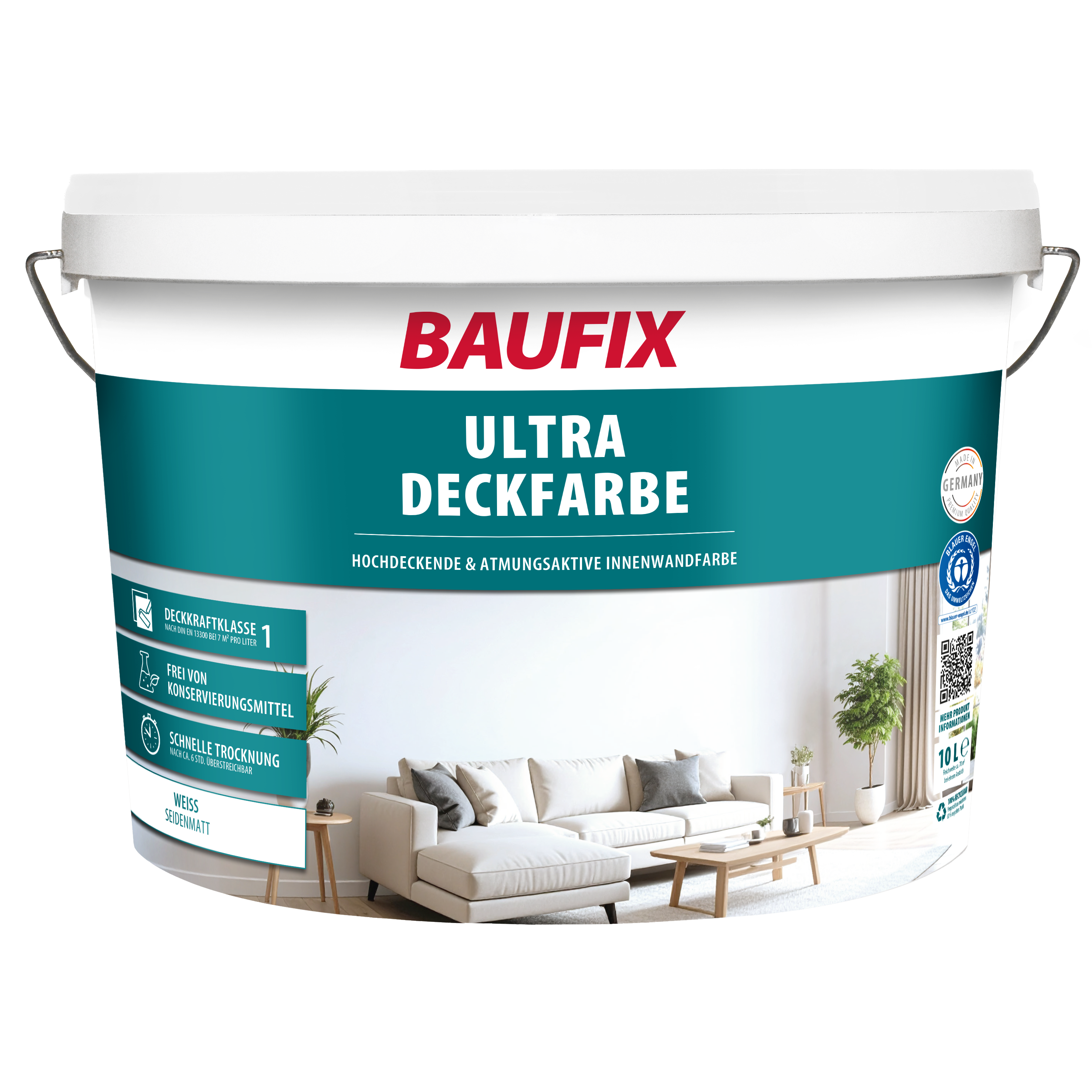
Unsere Wandfarbe: BAUFIX Ultra-Deckfarbe
- Deckfähigkeit Klasse I nach DIN EN 13300 bei 7 m²/l/l
- Nassabriebbeständigkeit Klasse III nach DIN EN 13300
- perlweiß seidenmatt
- deckt perfekt
- emissionsarm
- für Wände & Decken im Innenbereich